This year’s meeting unfolded against the backdrop of the 1700th anniversary of the First Council of Nicaea (325 AD), a milestone being honoured by churches throughout the world. The anniversary offered a gentle invitation to look back at our shared roots while dreaming forward together.
Irish Inter-Church Meeting 2025: Reflecting on Nicaea, Unity and the Future of Christian Witness
The Irish Inter-Church Meeting (IICM) gathered on 13th-14th November 2025 for two days marked by prayer, friendship, honest conversation and a shared longing for unity. This year’s meeting unfolded against the backdrop of the 1700th anniversary of the First Council of Nicaea (325 AD), a milestone being honoured by churches throughout the world. The anniversary offered a gentle invitation to look back at our shared roots while dreaming forward together.
From the very beginning, we were reminded that Nicaea was far from a tidy moment in history. It was a gathering where strong convictions met, where tensions surfaced, and where people listened, sometimes painfully, to one another. Out of that struggle, through the work of the Holy Spirit, a common declaration of faith emerged. As one speaker reflected, it took time, humility and conversion for the Creed to be fully received; yet today, its words are prayed by billions.
Although the physical city of ancient Nicaea (modern-day Iznik) has changed beyond recognition, the Nicene Creed continues to stand as a shared “grammar of faith”, a map for understanding who we are and who God calls us to become together. This anniversary created a natural space for IICM participants to ask: What possibilities does this shared heritage open for us now? What responsibilities does it place on our shoulders?
After a warm welcome from RC Bishop Brendan Leahy, Co-Chair of the Irish Inter Church Meeting including a greeting from Co-Chair Bishop Sarah Groves (Moravian Church) who could not be present, Rev. Dr Karen Campbell (General Secretary of the Irish Council of Churches/Inter Church Meeting) set the scene and introduced Claire Sego’s creative initiative: resourcing local churches to explore the Nicene Creed in their Advent services (https://www.nicaea1700.net/). Her work, simple, imaginative and profoundly practical, reminded us that the Creed is not only a theological text but something to be prayed, sung, and brought to life in our communities.
Ancient Faith, United Future? — Rev. Dr Liam Fraser1
Rev. Dr Liam Fraser then opened the conference with a rich, accessible and at times deeply moving overview of Nicaea, its context, and its enduring significance. He emphasised that unity does not mean uniformity, and difference, when held within the love of the Trinity, can become a source of creativity rather than division.
His reflections explored:
• History alive with faith
Fraser noted how the effects of Nicaea reached Ireland early. The famous “St Patrick’s Breastplate,” with its profound trust in Christ’s divinity, would be “impossible without Nicaea.” The journey from Nicaea (325) through Constantinople (381) and Chalcedon (451) revealed a Church constantly wrestling with how best to articulate the mystery of Christ.
• Theology and unity woven together
Billions of Christians profess the Nicene Creed. Fraser highlighted how this shared profession functions as a theological anchor and a near-universal foundation for unity. Even in times of disagreement—such as
1 Rev. Dr Liam Fraser, Minister of St Michael’s Parish Church in Linlithgow, is widely respected for his work on the Church’s mission and identity today. A former Convener of the Church of Scotland’s Theological Forum, he brings a thoughtful, ecumenical approach to questions of faith, unity, and the life of the Church.
debates on sexuality or struggles to recognise each other’s baptisms—the Creed remains a compass pointing us back to Christ.
• Ecumenical hope
For Fraser, the ancient faith of Nicaea may hold the key to the Church’s future. In an age of global Christianity and ethnic diversity, the Creed still provides the broad, hospitable space within which dialogue can flourish. The Faith & Order work of the World Council of Churches continues to use it precisely in this way.
Panel Discussion – “I Believe”
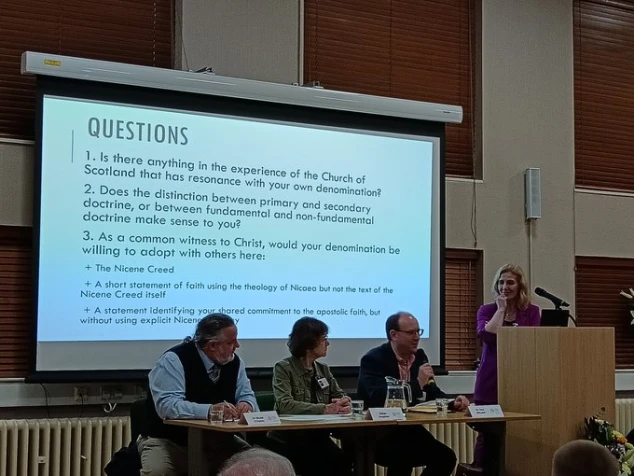
The panel with Gillian Kingston (Methodist Church), Dr Miceal O’Hurley (Greek Orthodox Church) and Dr Tom McLean (St Patrick’s Pontifical University), invited us into something tender and personal: What does it mean for me to say “I believe”? And how does “I believe” become “we believe”?
Their reflections reminded us that unity is often most visible in lived relationships—in how we pray with one another, how we share the everyday joys and burdens of discipleship, and how we recognise the presence of Christ in one another.
A Moment of Beauty: The “O Antiphons” and the Language of Creativity
One of the most memorable moments of the gathering came as we prayed and reflected around artistic interpretations of the “O Antiphons.” Each Antiphon was brought to life through a unique creative display, some specially commissioned for the occasion. It became clear that art, music and creativity have a unique power in dialogue. Where theological language can sometimes feel heavy, beauty opens hearts. As we moved from one Antiphon to the next, guided by a thoughtfully prepared order of service, we experienced how that music, silence and visual art allowed us to enter Advent hope together in a deeper way than words alone could offer. In those moments, unity was not something discussed but something shared—felt, seen, and sung.
DAY 2
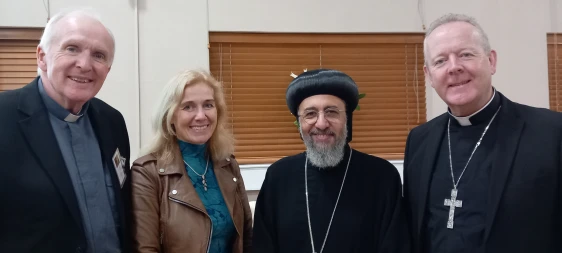
The second day began with a profound address from Archbishop Angaelos the first Coptic Orthodox Archbishop of London. He drew us back to the heart of Nicaea, not politics, not cultural tensions, but a crisis about the person of Christ. “They said He was not God,” he reflected, “and the Church gathered, of one accord, to proclaim who He truly is.”
Archbishop Angaelos touched on:
• The natural collaboration between civic authority and the Church at Nicaea
• St Paul’s appeal in 1 Corinthians: “Speak the same thing”
• Ecumenism as a beautiful mosaic of difference
• St Athanasius’ remarkable role as a young deacon at Nicaea
• The sobering reality that 4 out of 5 persecuted believers in the world today are Christians
He then described the four pillars of Coptic Christian identity: ecumenism, monasticism, martyrology and witness. Dialogue, he reminded us, is not compromise, yet even when full sacramental agreement is not possible, “we can stand together on the 90% we share.”
Asked whether another Nicaea could ever happen, he responded thoughtfully: “Perhaps. Today the ‘heresies’ are different—around gender, assisted dying, moral questions—but the world needs us to speak with truth, love and grace.”
Research Insights — Gladys Ganiel & Caoimhe Ní Dhonaill
Professors Ganiel and Ní Dhonaill from Queen’s University then presented their findings on religious life in Ireland after COVID-19. Their sociological lens, spanning Christian, Muslim, and humanist perspectives, generated rich discussion around trust, safeguarding, compassion and the role of doctrine in shaping communities that walk together as “one body.”
Conversation in the Spirit — Looking 1700 Years Ahead
The final session, led by Julieann Moran (General Secretary of the Synodal Pathway of the Catholic Church), invited participants to listen deeply to the Holy Spirit and to one another. The question was simple yet stretching:
What commitments can the churches make today as custodians of a shared Creed for the next 1700 years?
Themes that emerged included:
• Seeing the Creed as a path to compassion
• Renewing ourselves daily in prayer
• Choosing kindness and relationship as signs of unity
• Allowing mission to be led by the Spirit, not strategy
• Witnessing together amid new moral and social challenges
• Recognising Christ’s descent into hell as a model for entering places of deep suffering
• Gratitude for the stability the Creed brings in polarised times
Conclusion — “Towards the Bond of Peace”
Bishop Brendan Leahy closed with a heartfelt meditation on Ephesians 4:3:
“Make every effort to maintain the unity of the Spirit in the bond of peace.”
Drawing on St John Chrysostom and St Cyprian, he reminded us that unity is not simply an ideal but a responsibility—a garment woven together by love, which we must take care not to tear.
As people prepared to leave, there was a palpable sense of gratitude: that the Nicene Creed, far from being an ancient text frozen in the fourth century, continues to call us forward. It invites us to recognise one another, to receive one another’s gifts, and to walk together—as disciples, as churches, and as people of hope.